With over $3 billion in revenue in Q1 2026 alone, according to Shopify's Q1 2026 financial results, Shopify has cemented itself as one of the leading SaaS e-commerce platforms worldwide, empowering entrepreneurs and major retailers alike to build custom online storefronts. Whether you’re a side-hustler launching your first product line or a global brand managing high-volume sales, Shopify offers scalable tools to get you selling fast.
But speed and simplicity come at a cost: the very features that make Shopify so appealing to legitimate businesses are also being exploited by bad actors.
Fake Shopify stores can be spun up in minutes for as little as a $1 trial, and bad actors launch new ones within hours of a takedown, posing as real brands, deceiving customers, and stealing revenue from legitimate businesses. If your brand is being impersonated, it’s critical to act fast.
Here’s how Shopify works, how scammers abuse it, and what brand owners can do to fight back.
TLDR:
- Fake Shopify stores can launch in minutes for $1 and reappear within hours of takedown.
- Report stores via Shopify's merchant form with IP registration docs and screenshots.
- Shopify takedowns resolve in days; domain enforcement takes weeks to months.
- Scammers pre-register backup domains and scrape your site content to relaunch stores fast.
- MarqVision automates detection and takedown across Shopify, Amazon, and other platforms.
What Is Shopify, and How Does It Work?
Shopify is a cloud-based e-commerce platform that allows anyone to create an online store in minutes.
With Shopify, merchants can customize storefronts using branded themes and third-party apps, manage customer data, use built-in point-of-sale (POS) functionality for in-store purchases, and access a suite of analytics, marketing tools, and payment gateways….all from a single system.
The Rise of Scam Shopify Stores
Fake Shopify stores are a growing threat across the e-commerce ecosystem. These stores often look polished on the surface but are designed to deceive. Some common warning signs include:
- Domains: Look for three common patterns. First, “brand name + region or product” combos like nike-korea-outlet.com or adidasclearanceus.com that pair a real brand with a generic modifier. Second, homoglyph domains that swap in lookalike characters, such as a Cyrillic “а” in nіke.com or a zero for an “o” in g00gle-store.com, to evade detection. Third, throwaway domains that are random letter strings (xkqzmart.shop) or sit on cheap TLDs like .top, .shop, or .store with a registration date only days or weeks old.
- Unrealistic Discounts: Offering deep discounts that would be impossible for legitimate retailers with production and logistics costs (ex. free shipping from China).
- Social Media & Customer Reviews: Watch out for social media accounts with fewer than three posts or little to no genuine engagement. While the comment section can offer clues, be cautious: scammers frequently use bots to flood posts with fake praise and are quick to delete any negative feedback or warnings from real users.
- No Contact Info: Missing addresses, broken email links, and no phone numbers.
These scams damage brand reputation and cut into revenue, snowballing into a serious issue before the brand even becomes aware. Customers hold the real brand accountable when orders never arrive or when poor-quality knockoffs show up at their door, leading to legal and reputational troubles alike. Even worse, traffic that should be driving sales on your official site is instead being rerouted to the fake sellers, draining possible revenue opportunities.
How to Spot a Fake Shopify Store: Red Flags for Consumers
Before falling victim to a scam, consumers need to know what warning signs to look for. Fake Shopify stores are becoming increasingly sophisticated, but they still leave telltale traces. Here are the red flags that should make you think twice before clicking "Buy Now."
Suspiciously Low Pricing
If a deal looks too good to be true, it probably is. Scammers lure shoppers with deep discounts that legitimate retailers with real overhead costs could never match. Watch for products priced 50-90% below the manufacturer's suggested retail price, "limited-time" offers that never expire, and prices that undercut every authorized retailer by significant margins. A designer handbag listed at $89 when the official price is $890 is a clear warning sign.
Missing or Incomplete Contact Information
Legitimate businesses make it easy to reach them. Fake stores do the opposite. Look for missing physical addresses or addresses that lead to residential homes or empty lots when checked on Google Maps, email addresses using free providers like Gmail or Yahoo instead of branded domains, and broken or non-existent phone numbers. If the only way to contact the seller is through a generic contact form with no other verification, proceed with extreme caution.
Poor Website Design or Stolen Images
Scammers often scrape content directly from legitimate brand sites, but they rarely get every detail right. Red flags include product images with watermarks from other retailers still visible, inconsistent fonts and layouts across different pages, and broken links or placeholder text left in the template. You can verify suspected stolen images by using reverse image search, if the same photo appears on dozens of unrelated sites, you're likely looking at a fake.
Lack of Legitimate Customer Reviews
Authentic customer feedback is hard to fake at scale. Be wary of stores with zero reviews despite claiming to have been in business for years, only five-star reviews with generic praise and no specific product details, and reviews that all appeared within the same short time period. Check for independent reviews on trusted platforms like Trustpilot or the Better Business Bureau, if the store doesn't exist there, that's a major red flag.
Unclear or Missing Return Policies
Legitimate retailers stand behind their products with clear return and refund policies. Scam stores either hide this information or make it deliberately vague. Watch for policies written in broken English or filled with grammatical errors, terms that make returns nearly impossible (such as "all sales final" on every product), and refund policies that require you to pay return shipping to foreign addresses with no tracking. If you can't find a return policy at all, don't make the purchase.
Requests for Payment Outside Shopify's System
Shopify's built-in payment system offers buyer protection. Scammers know this and try to circumvent it. Never agree to payment requests via wire transfer, cryptocurrency, or peer-to-peer apps like Venmo or Zelle instead of credit card, sellers who ask you to complete the transaction via email or messaging apps outside the platform, or stores that require full payment upfront for "custom" or "pre-order" items with no buyer protection. Legitimate Shopify merchants always process payments through secure, traceable channels.
How to Report a Shopify Store
If you suspect that a Shopify store is infringing on your brand, follow these steps to report it:
- Gather Evidence. Collect all relevant proof of infringement, including:
- Screenshots of the store
- Product listings that use your IP
- URLs, order confirmations, or customer complaints
- Any correspondence with the store
- Go to the Shopify Help Center. Navigate to the “Report a Merchant” section.
- Fill Out the Report Form. Choose the relevant type of violation: trademark infringement, copyright infringement, spam, etc. Be as specific as possible. Include any relevant IP registrations (trademarks, copyrights), examples of infringement, and details about the unauthorized use.
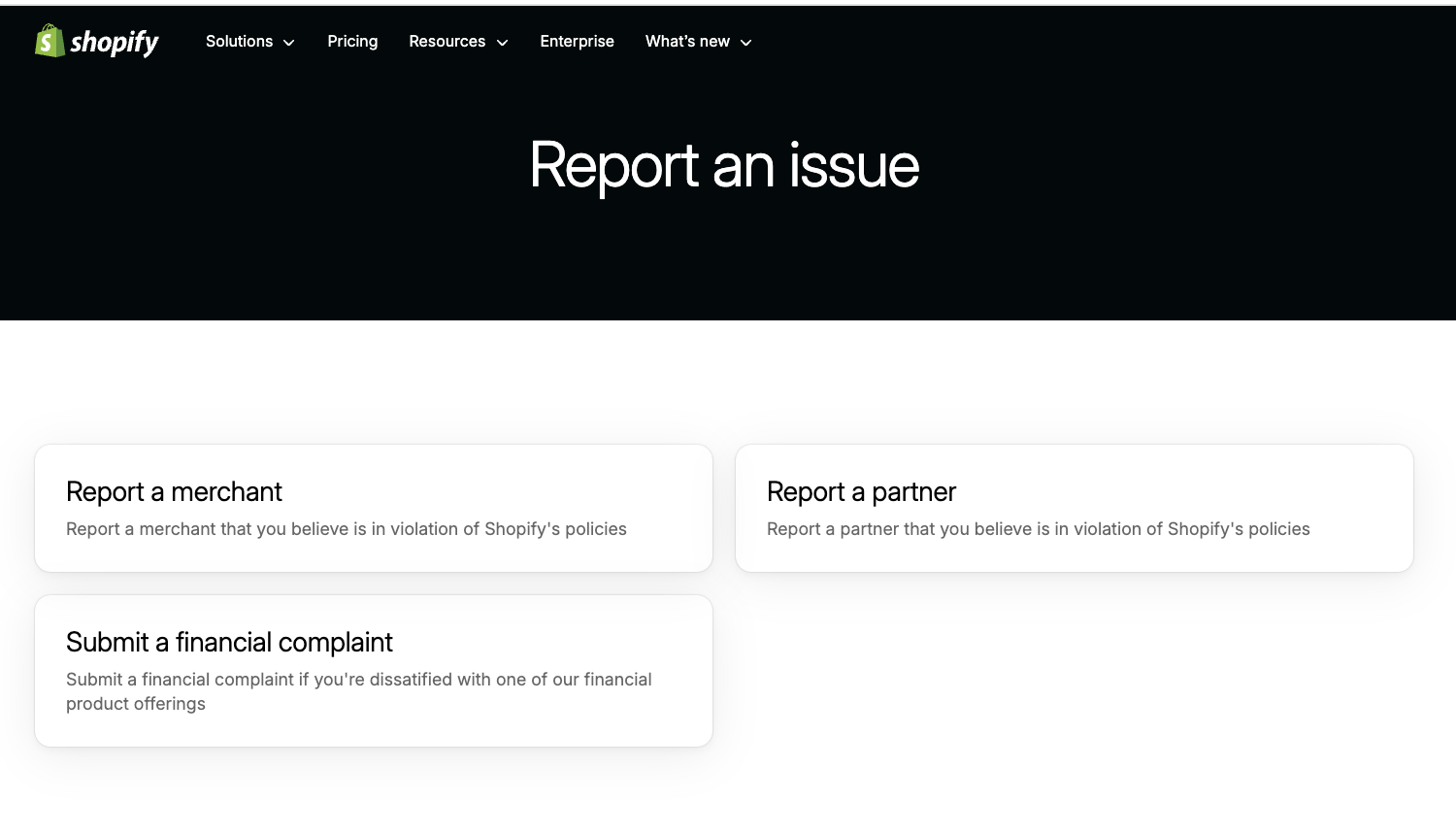
- Submit the Report. Shopify will confirm receipt of your complaint and investigate the issue. If your claim is verified, Shopify may remove the listing, take down the store, or ask for additional documentation.
What Happens After You Report?
Shopify has clear policies against selling counterfeit goods and infringing on intellectual property. When reports are submitted with strong supporting evidence, Shopify reviews them and may act on verified violations, though resolution times vary by case.
However, that doesn’t mean the problem is gone for good.
Fighting Back: How Brands Can Scale Their Protection
The reality is that manual enforcement alone isn’t enough anymore. Organized counterfeit operations run scripts that register dozens of new stores at once, pre-buy backup domains before the first store is even reported, and relaunch a fresh storefront within hours of a takedown, leaving your brand to play a game of digital whack-a-mole. This leaves brand owners stuck in a reactive loop, constantly monitoring for new abuses.
That’s where MarqVision comes in. Our AI-powered platform automates the detection and takedown of counterfeit listings across e-commerce platforms, including Shopify, Amazon, and beyond. Instead of spending hours combing through scam sites and submitting reports manually, your team can focus on higher-level strategy while we handle the enforcement.
If your brand is being targeted by fake Shopify stores, don’t wait for the damage to escalate. Report them. Take action. And consider a long-term solution to stay ahead of the curve.
FAQ
Can I build an enforcement case against a Shopify store without trademark registration?
No. Shopify requires verified IP rights, typically trademark or copyright registration, to process infringement reports and take down infringing stores. Without registration documentation, your complaint lacks the legal standing Shopify needs to act, leaving fake stores active even when the violation is obvious.
Shopify takedown vs domain enforcement, which removes fake stores faster?
Shopify takedowns through their merchant reporting system typically resolve within days when backed by strong IP documentation, while domain enforcement via UDRP or registrar abuse reports can take weeks to months. For immediate threat removal, file directly with Shopify first; pursue domain action in parallel for repeat offenders operating multiple storefronts under different URLs.
What's the fastest way to detect new fake Shopify stores targeting my brand?
AI-powered monitoring platforms scrape e-commerce sites continuously and flag unauthorized use of your brand name, logos, and product images within hours of a store going live. Manual monitoring, searching your brand name plus "shop" or ".myshopify.com" weekly, catches some threats but misses stores using misspelled domains, foreign characters, or non-obvious URLs that automated detection identifies instantly.
How do scammers spin up new Shopify stores so quickly after takedowns?
Shopify's low barrier to entry lets bad actors register new stores in minutes using different email addresses, payment methods, and slight domain variations while scraping the same stolen content from your official site. Scammers often pre-register multiple backup domains before the first store is reported, making manual enforcement a cycle of reactive takedowns without addressing the source.
When should I escalate from Shopify reporting to legal action?
Escalate when the same seller repeatedly launches new stores after takedowns, when counterfeit sales volume causes measurable revenue loss or customer safety issues, or when the infringer operates across multiple platforms beyond Shopify's jurisdiction. If monthly enforcement requests exceed your team's capacity or repeat offenders return within 72 hours of removal, you need automated detection and cross-platform enforcement beyond Shopify's internal reporting system.
Stay up to date on the latest IP Protection content from MarqVision.


4 Enforcements a Week to 400: Scale Brand Safety with Marq AI

Don’t Just Find Counterfeits. Dismantle the Entire Network.

.png)
Discover the latest trends and challenges in IP protection

Take Control of Your Trademarks with MARQ Folio
Renew and Manage Your Trademarks Easily With MARQ Folio

We’re waiting to hear from you

See the best brand protection solution in action

Don’t let piracy steal your growth

Talk to us about your brand protection problems