

Fake products have been present on Taobao for a long time. These counterfeits target successful products, often from up-and-coming brands, hoping they don’t have the resources or experience to stop counterfeiting on Taobao.
Follow MarqVision’s easy step-by-step guide to reporting and removing fake and counterfeit products from Taobao’s online marketplace.
TL;DR: Key Takeaways
- Evidence first: Before filing, gather your trademark certificates, proof of ownership, infringing listing screenshots, and any seller communications. You can submit up to 200 listings per complaint, so batch them strategically.
- One account, multiple platforms: Registering on the Alibaba Group IPP Platform covers Taobao, Tmall, Tmall.hk, and 1688, while AliExpress, Alibaba.com, and Lazada now use a separate International IP Protection Platform (split as of November 1, 2023).
- Registered trademark required: Taobao's system only recognizes approved IP rights. A Chinese trademark (mainland, Hong Kong, or Taiwan) carries the strongest enforcement standing; foreign trademarks are accepted but slower to process.
- Takedowns resolve in 1 to 2 business days, but relisting is common. Record seller IDs and listing URLs immediately after removal and run a follow-up keyword search within one week to catch re-listed fakes early.
- Manual enforcement doesn't scale: For brands facing high-volume counterfeiting across multiple platforms, AI-native solutions like MarqVision automate detection and removal across 1,500+ global marketplaces, freeing your team from repetitive manual workflows.
Step 1: Gather Documentation and Evidence
Before reporting the IP infringement, gather as much evidence as possible to support your claim. This should include documentation and information regarding the infringing listings.
- Documentation of your intellectual property rights.
- Proof of ownership or authorization to act on behalf of the IP rights owner.
- Screenshots of the infringing product listings, clearly showing the infringement.
- Any communication you've had with the seller regarding the infringement.
- Proof that the products being sold on Taobao are indeed counterfeit or infringing on your rights.
Remember, you’ll be able to submit up to 200 listings in a single complaint later on, so organize these reports into batches to save yourself time.
Step 2: Create your Alibaba Account
To manage and protect your IP on Taobao, you’ll need to register an account on the Alibaba Group IPP Platform. Being part of the Alibaba ecosystem is necessary for enforcing your rights, but it’s also the start of a professional relationship that grows and improves over time as you develop mutual trust.
Note: As there are many sites under the Alibaba umbrella, this process will also help brands looking to enforce their IP rights on Tmall.com, Tmall.hk, and 1688.com.
The first step is to create an account. Head over to the Alibaba Group IPP Platform account registration page.
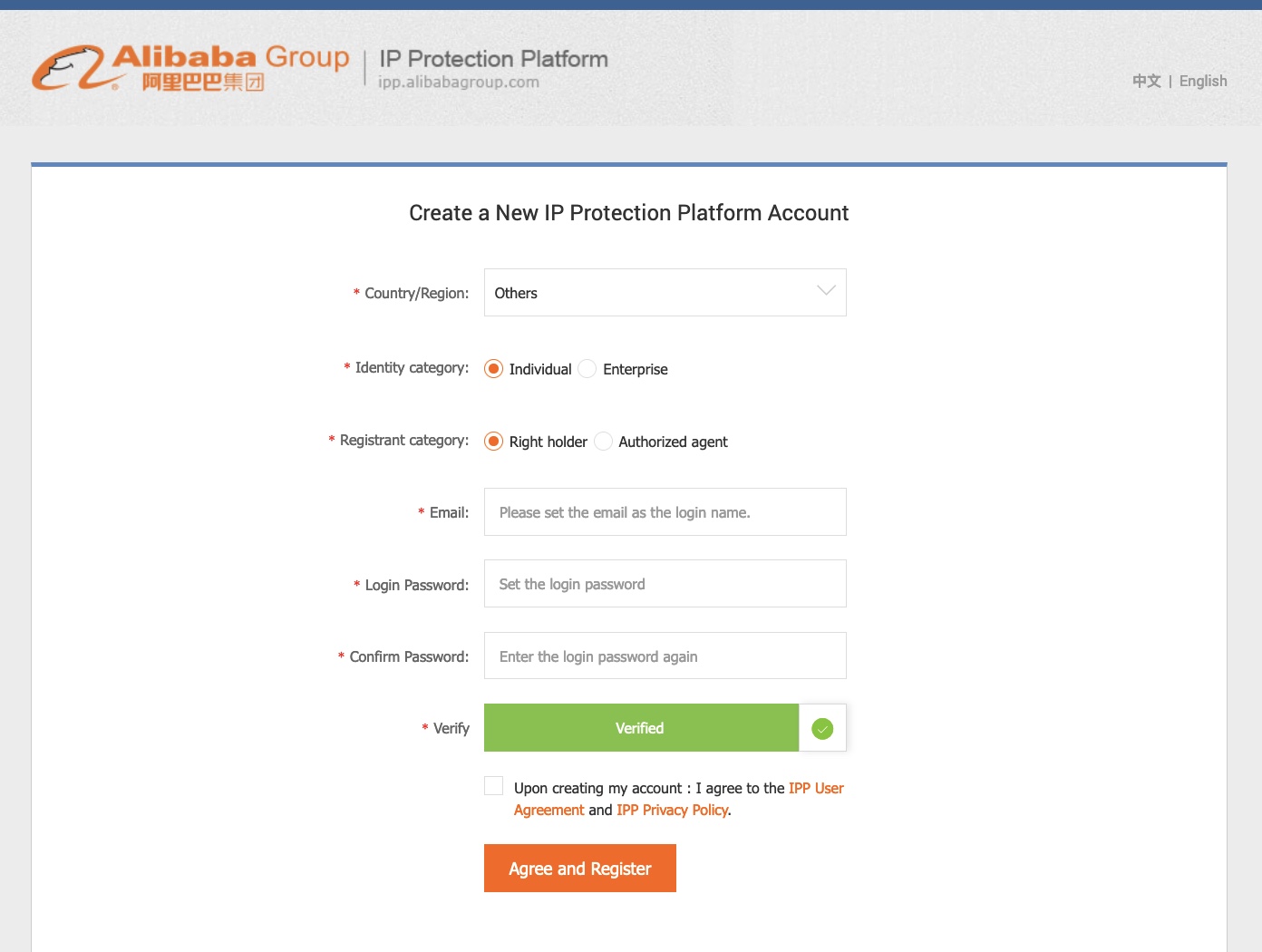
Simply follow the steps as they appear as standard, which involve providing your login credentials and verifying your email account with a check code.
Note: Some users have raised issues with the login and verification procedure. If this happens, first confirm your browser is allowing third-party cookies. If the problem continues, attempt another log-in through a mobile device. Alternatively, head to Alibaba’s FAQ portal for more solutions.
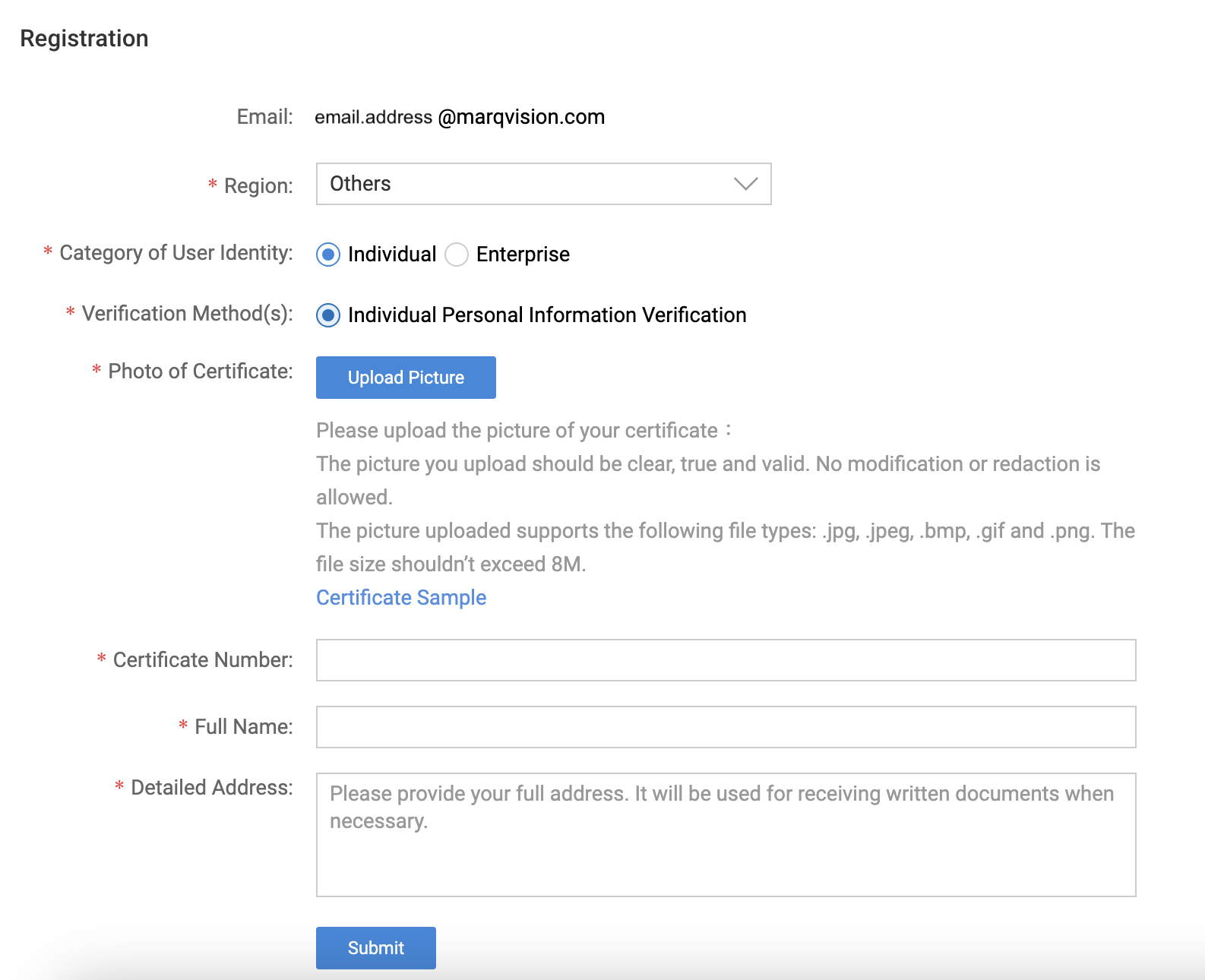
With the account created, you can now move on to enforcing your IP rights.
Step 3: Submit Your IP Data
Protecting your trademark on Alibaba requires you to list your IP documentation on their platform, which they will then use to combat any infringing listings within their marketplace. For a broader look at how to enforce IP rights on Alibaba, see our dedicated guide.
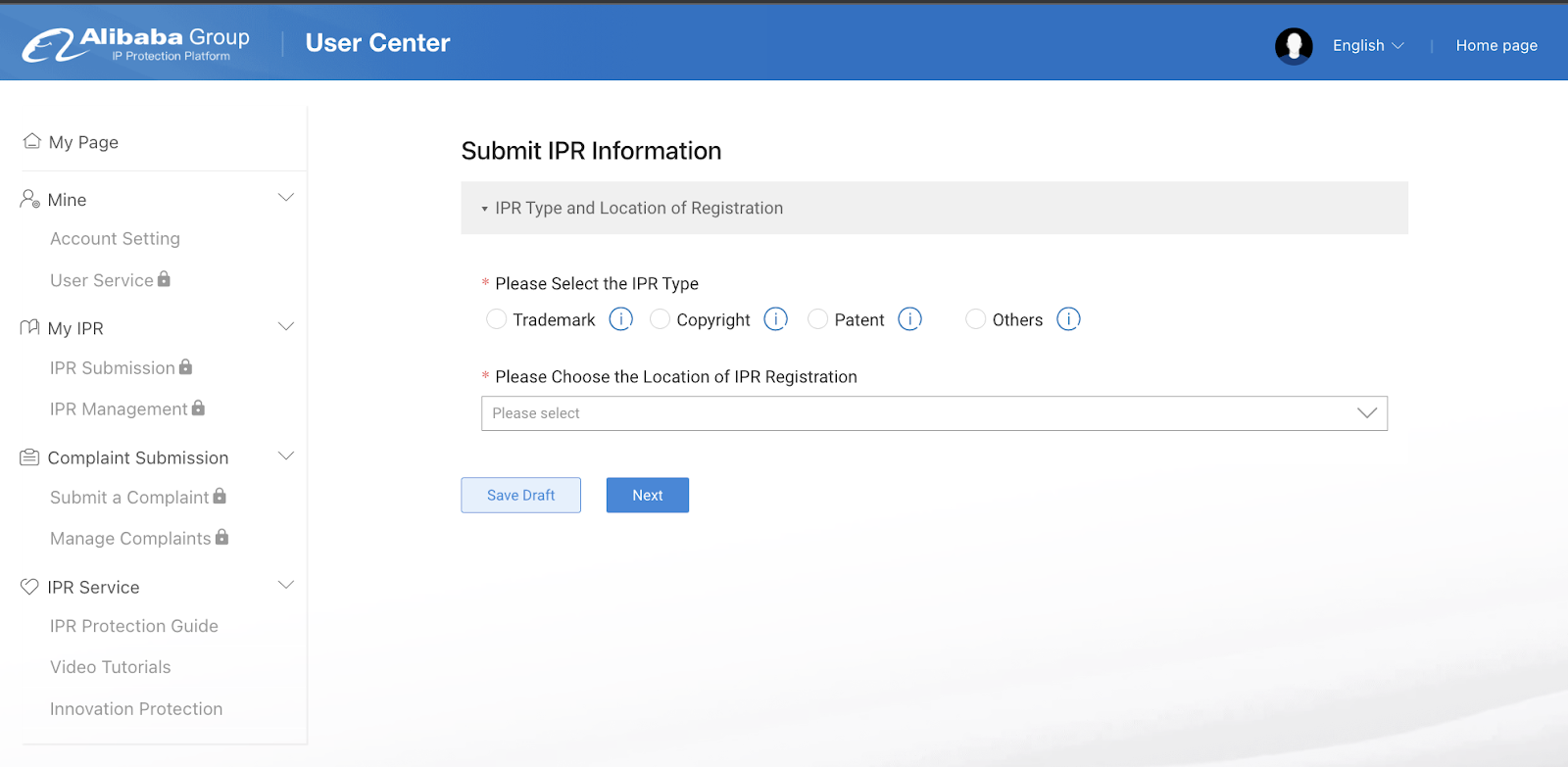
Access the IPR Info page, as seen in the image above, and select “Trademark”, and the country of registration. As Alibaba is a Chinese-owned company, a trademark registered in mainland China, Hong Kong, or Taiwan will be much easier to protect, but the option for “Others” will cover trademarks registered in Europe, the US, and other foreign countries.
Upload your trademark certificate and certificate for trademark class for the next step and complete the fields that appear below. You’ll need to answer the following:
- Name of the trademark you submitted
- User customized IPR name (optional)
- Registration number of the trademark you submitted
- Registrant of the trademark you submitted
- Expiration date of the trademark you submitted
- Class of goods/ service of trademarks you submitted
- Brand related to the trademark you submitted
- Whether the submitted trademark has been renewed
- Whether the submitted trademark has been assigned before
- Whether the submitted trademark has been altered before
*If you are the agent of the trademark owner, you must also attach a valid Power of Authorization signed by the owner.
With your account created and your IP documentation uploaded to Alibaba's system, you can now move to removing counterfeit products.
Step 4: Use Taobao’s Reporting System to Remove Fakes
Log in to your Taobao account, or register for an account, as covered in the previous steps, if you haven’t made one yet. Having an account is necessary to report a counterfeit product, but it’s very worthwhile in the long run to be a part of Alibaba’s IPR ecosystem.
In the User Center, click on “Submit a Complaint”, as marked in the image below
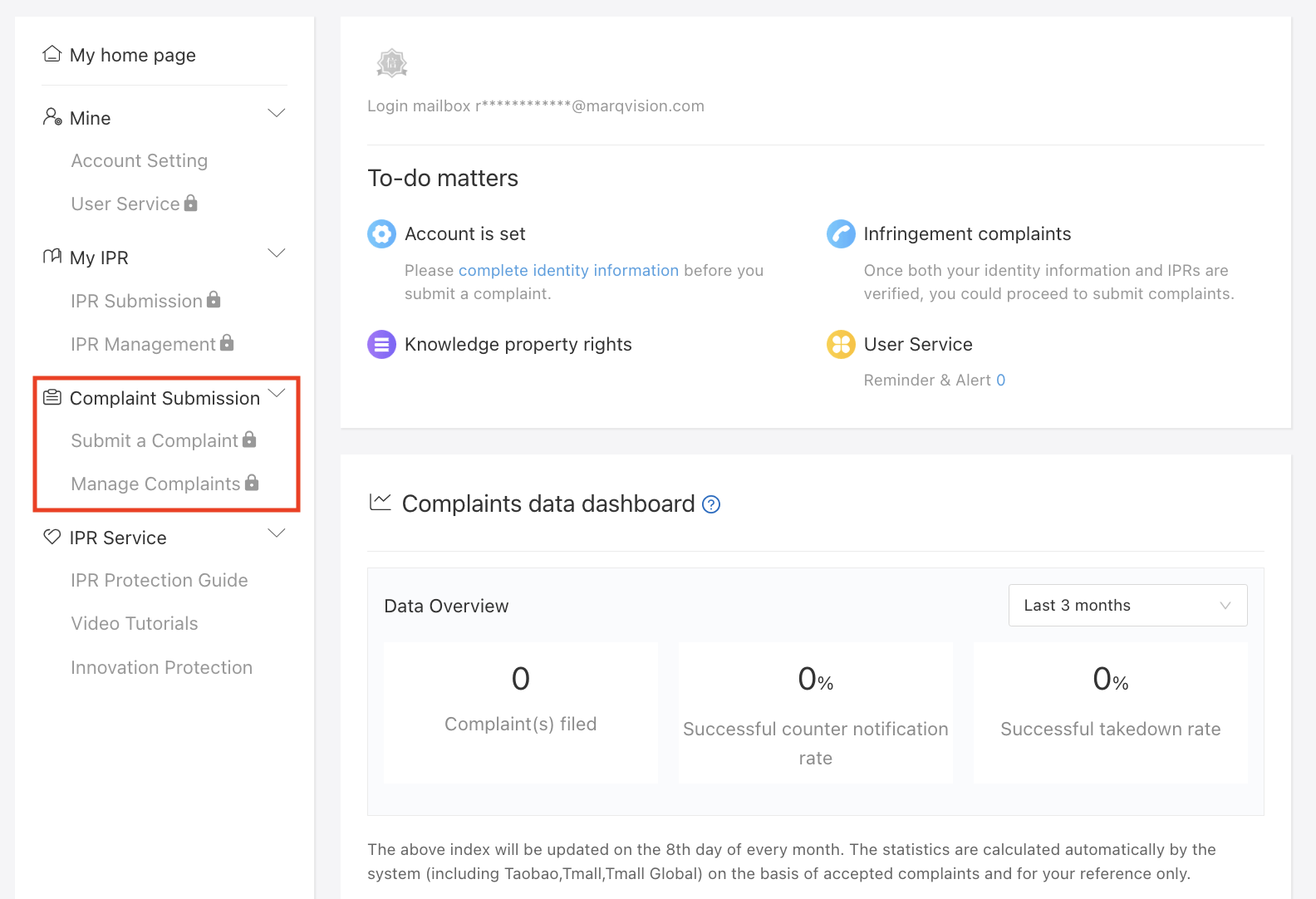
Choose the appropriate complaint website based on where the infringement is occurring.
Alibaba's IPR reporting process combines reporting platforms for the sites within its family: Taobao, Tmall, Tmall Global, 1688, Alibaba, and AliExpress. Taobao and Tmall use the Taobao Intellectual Property Protection Platform, while 1688, Alibaba, and AliExpress use AliProtect. For a dedicated walkthrough of the international platform, see our AliExpress counterfeit takedown guide.
The Alibaba IP Protection Platform has been split into two since November 1, 2023.
Then, click on "Enter Listings." You'll be presented with two options for reporting here:
- Option 1: Enter the product keyword and select the appropriate website to search for the product.
- Option 2: Directly enter the specific product listings.
Select the product listings and click "Continue."
Match the selected listings to the correct IPRs (only approved IPRs will be displayed).
Input your complaint reason. If you have any supporting documents, upload them here.
Step 5: Submit and Wait for Processing
Once you have completed the necessary information and submitted your complaint, it should be processed by Taobao within 1-2 business days, however this timeframe isn’t a guarantee, so be patient.
You will receive a confirmation of your complaint submission from Taobao, and the platform will review your case. Be prepared to provide any additional information or evidence as requested during the review process.
Remember to be thorough and accurate in your submission, and confirm your IPR information is up to date and approved to enhance the effectiveness of your complaint.
Once a listing is successfully removed, immediately record the seller's store ID and any associated listing URLs before they disappear. Counterfeit sellers on Taobao routinely re-list the same products under new listing IDs within days of a takedown. Schedule a follow-up keyword search within one week of confirmed removal to catch relisted products early. Keep a running log of all infringement cases, including seller IDs, listing URLs, complaint reference numbers, and removal dates, to build a searchable evidence base that speeds up future batched complaints and strengthens your enforcement history over time.
Frequently Asked Questions
How long does Taobao take to process a counterfeit complaint?
Taobao typically processes complaints within 1 to 2 business days, but this timeframe is not guaranteed. Complex cases or submissions with incomplete evidence may take longer. Submit all supporting documentation upfront, including your trademark certificate, proof of ownership, and screenshots of infringing listings, to avoid delays caused by back-and-forth requests for additional information.
Do I need a registered trademark to file a complaint on Taobao?
Yes. Taobao's reporting system only recognizes approved IP rights, meaning a registered trademark is a hard prerequisite for filing. A trademark registered in mainland China, Hong Kong, or Taiwan carries the strongest enforcement standing on the platform. Trademarks registered in Europe, the US, or other foreign jurisdictions can still be submitted under the "Others" category, but expect the process to be slower and approvals less straightforward. If your trademark is still pending registration, you will not be able to submit enforceable complaints through this channel until registration is confirmed.
How many listings can I report in a single complaint?
Taobao allows up to 200 listings per complaint submission. To use this efficiently, organize your infringing listings into batches before submitting instead of reporting them one at a time. Group listings by seller or by the IP right they infringe to keep your evidence organized and your complaint records easy to reference for future enforcement.
Does this process also work for Tmall, 1688, and other Alibaba-owned platforms?
Partly. The Alibaba Group IPP Platform account you create covers multiple Alibaba-ecosystem properties, but the reporting workflow splits into two separate platforms as of November 1, 2023. Taobao, Tmall, Tmall.hk, and 1688 use the Alibaba IP Protection Platform. AliExpress, Alibaba.com, and Lazada use the Alibaba International IP Protection Platform. Make sure you are filing through the correct platform for the marketplace where the infringement is occurring, because submitting to the wrong platform will delay or void your complaint.
What should I do if a seller re-lists the same fake product after a successful takedown?
Relisting is common. Once a removal is confirmed, immediately record the seller's store ID and any associated listing URLs before they disappear. Schedule a follow-up keyword search within one week of the confirmed removal to catch relisted products early. Keep a running log of all enforcement cases, including seller IDs, listing URLs, complaint reference numbers, and removal dates, so you can submit batched follow-up complaints efficiently and build an enforcement history that strengthens future claims.
What if the manual reporting process is too slow or resource-intensive for my team?
Manual Taobao enforcement is effective for individual cases but does not scale for brands facing high-volume counterfeiting across multiple platforms. Each submission requires considerable preparation time, and relisting means the work is never truly finished. AI-native brand protection platforms like MarqVision automate detection and removal across 1,500+ global marketplaces, including the full Alibaba ecosystem, freeing your team from manual reporting workflows and achieving enforcement at a speed and scale that in-house teams cannot match alone.
How does AI detect counterfeit goods on e-commerce platforms like Taobao?
Manual keyword searches catch only the listings counterfeiters want you to find. AI-native detection closes the gap by combining computer vision, language understanding, and behavioral pattern analysis to surface infringing listings that evade manual sweeps.
The core mechanism works in three layers. First, computer vision models compare product images, such as logos, packaging, label typography, and color profiles, against your authenticated brand assets, flagging visual matches even when sellers deliberately alter image angles or apply slight color changes to dodge perceptual hashing filters. Second, language models parse listing titles, descriptions, and seller-generated keywords to identify evasion patterns: deliberate misspellings, character substitutions (e.g., Cyrillic lookalikes), and keyword combinations that counterfeiters use to stay off branded search results. Third, seller behavior analysis clusters accounts by shipping origin, pricing bands, store age, and inventory overlap to identify coordinated seller networks operating under multiple storefronts, a pattern manual enforcement misses entirely because it reviews listings in isolation.
The practical consequence is detection latency compressed from days to minutes. On high-velocity platforms like Taobao, where a new counterfeit listing can complete its first transaction within hours of going live, the speed gap between manual monitoring and AI detection is the difference between catching a listing before or after customer harm occurs. MarqVision's system, for example, runs continuous cross-platform scans across 1,500+ global marketplaces, surfacing infringing listings and routing confirmed violations directly into the takedown workflow, without requiring a brand analyst to initiate each search manually.
What tools should I use to find and remove fake products from Amazon, Taobao, and other global marketplaces?
The right toolset depends on your counterfeiting volume and the number of platforms where infringement is documented. For brands dealing with isolated listings on one or two marketplaces, native platform reporting systems, such as Taobao's IPP Platform and Amazon's Project Zero and Report a Violation tool, are sufficient for individual takedowns, though each requires manual setup, evidence preparation, and ongoing monitoring to catch relistings.
For brands facing high-volume or multi-platform counterfeiting, native tools create an enforcement bottleneck: each platform requires a separate workflow, separate IP documentation submission, and separate complaint queue management. The volume of relisting means enforcement becomes a revolving door instead of a resolved case.
AI-native brand protection platforms tackle the scale problem directly. MarqVision, for example, automates detection and takedown across 1,500+ global marketplaces, including Taobao, Tmall, Amazon, AliExpress, and Lazada, using computer vision and behavioral analysis to surface infringing listings continuously instead of reactively. For the Amazon-specific workflow, see our dedicated guide on how to remove counterfeits from Amazon. For a broader view of cross-platform strategy, our online brand protection strategies guide covers how to structure enforcement across channels.
How do counterfeit products on online marketplaces affect my brand's revenue and customer trust?
The damage runs in two directions simultaneously. On the revenue side, every fake unit sold is a lost authentic sale, but the cascading losses extend further. Counterfeit goods typically undercut genuine pricing by 40 to 80%, which trains price-sensitive buyers to anchor their expectations below your real price point, eroding your pricing power over time. Customs seizure data published by the OECD estimates counterfeit goods accounted for $467 billion in global trade in 2021; a meaningful share of that volume flows through platforms like Taobao, directly competing with legitimate brand inventory.
On the trust side, the damage is asymmetric and often permanent. A customer who unknowingly buys a counterfeit and receives a defective or unsafe product does not blame the counterfeiter. They blame your brand. Product reviews, social media complaints, and return requests all land on your reputation, not the seller's. Research cited by the International Chamber of Commerce estimates that one in four consumers who have a negative experience with a counterfeit product will not purchase from the brand again. On a platform like Taobao, where buyer reviews are given high visibility in search rankings, a cluster of fake-driven negative reviews can suppress your authentic listings' visibility at the same time it degrades conversion rates. Manual enforcement alone does not resolve the trust problem because by the time a listing is reported and removed, the transaction, and the reputational damage, has already occurred.
What is the difference between a counterfeit product and a gray market or unauthorized seller?
These are legally and practically distinct problems that require different enforcement responses.
A counterfeit product is a fake: it bears your trademark, trade dress, or other protected IP without authorization, and it was manufactured for the sole purpose of impersonating your authentic product. Counterfeits are a clear IP infringement. Taobao's complaint system exists precisely to handle them, and the steps in this guide apply directly.
A gray market product is an authentic product that was manufactured by or for you but is being sold through an unauthorized channel. For example, units originally produced for a specific regional distributor that are now appearing on Taobao without your authorization. The product is real; the distribution channel is not. Gray market sellers may not be infringing your trademark at all, which means Taobao's IP complaint pathway is often the wrong tool. Enforcement typically requires a parallel strategy: MAP (Minimum Advertised Price) policy enforcement, distributor agreement audits, and in some cases customs recordation to identify where inventory is leaking into unauthorized channels.
The practical boundary: if the product is fake, file an IP complaint. If the product is real but the seller is unauthorized, the enforcement path runs through contract, distribution controls, and pricing policy, not the IPP Platform. Many brands encounter both problems simultaneously on Taobao, which is why a monitoring program that can distinguish between the two signal types matters in practice before enforcement resources are allocated.
Do counterfeit and impersonation threats apply to B2B companies or APAC-focused brands as well as consumer product sellers?
Yes, and the assumption that counterfeiting is primarily a consumer-product or Western-brand problem leads to serious blind spots in B2B and APAC-native enforcement programs.
For B2B brands, the risk concentrates at a different point in the supply chain. Counterfeit industrial components, replacement parts, chemicals, and ingredients appear on B2B-oriented platforms (including Alibaba.com and 1688) and get purchased by procurement teams who assume they are sourcing authentic goods. A counterfeit bearing your brand name on an industrial component that subsequently fails creates product liability exposure that dwarfs the original sale value. The reputational channel is different (industry word-of-mouth, procurement audits, supply chain certification reviews) but the structural damage is the same: your trademark is being used without authorization to sell inferior goods at your brand's expense.
For APAC-focused brands, Taobao and its Alibaba ecosystem counterparts are not a peripheral enforcement consideration. They are the primary attack surface. Counterfeiting activity on Chinese platforms is disproportionately concentrated in categories where APAC consumer demand is highest: cosmetics, fashion, electronics, health supplements, and luxury goods. APAC-native brands often face a compounded problem: their trademark registrations may be weaker outside their home market, which reduces enforcement standing on international complaint channels, while domestic platform tools like the Alibaba IPP Platform reward brands that hold Chinese trademark registrations in particular.
Impersonation websites, meaning domains that copy your brand's visual identity, product descriptions, or store layout to capture traffic and fraudulent sales, operate across all verticals and geographies. B2B brands and APAC-focused companies are not exempt. If your brand has any measurable search presence, a lookalike domain can divert inbound leads, capture contact form submissions, or sell counterfeit versions of your product to buyers who believe they are on your official site. Enforcement against impersonation sites requires a separate workflow from marketplace takedowns: domain registrar abuse reporting, UDRP filings, and in some jurisdictions, direct legal action.
Automate Your IP Protection Online
Removing fake products from Taobao and other Chinese marketplaces is achievable even for smaller brands, and it matters: the OECD estimates counterfeit goods account for over $467 billion in global trade annually, with Chinese e-commerce platforms representing a large share of that volume. The same manual process applies when you need to remove counterfeits from Amazon. However, following this guide to remove fakes will uncover just how slow this process can be, and how much precious manpower it can take from smaller teams.
But, there is an easier way.
MarqVision automates the protection of IP rights online. We work in all the biggest online marketplaces in Asia and across the world, and even fight against infringements on social media and impersonating sites. To see how automation fits into a broader program, read about our online brand protection strategies.
Get in touch with us to learn how MarqVision, the leading AI-native brand protection solution, can protect your brand in every corner of the internet, freeing your in-house team to focus on business growth and international expansion.
Stay up to date on the latest IP Protection content from MarqVision.




4 Enforcements a Week to 400: Scale Brand Safety with Marq AI

Don’t Just Find Counterfeits. Dismantle the Entire Network.

.png)
Discover the latest trends and challenges in IP protection

Take Control of Your Trademarks with MARQ Folio
Renew and Manage Your Trademarks Easily With MARQ Folio

We’re waiting to hear from you

See the best brand protection solution in action

Don’t let piracy steal your growth

Talk to us about your brand protection problems