
Android apps are a critical product for countless businesses. From gaming and video streaming apps to core services in finance and healthcare sectors, and everything in between, companies in all industries are providing services to the billions of active Android devices worldwide.
In 2026, these apps are facing a major piracy threat. This threat is a form of media piracy, where unauthorized distribution of digital content undermines both revenue and user security.
Dedicated APK download portals like APKPure, APKMirror clones, and forums such as XDA threads host modified versions of many branded apps, known as MOD APKs. These modded apps provide users free access to paid features, remove ads, and offer other benefits while threatening the security of those very same users at the same time.
The growth in APK piracy should be a major concern for any business with an app in the Android ecosystem. Luckily, there’s a solution.
In this article, we’ll be providing an overview of MOD APKs; what they are, how they’re created, and the risks they pose to businesses and users alike.
TLDR:
- MOD APKs are modified Android apps that strip security, unlock paid features, and often inject malware while spreading through sites and forums outside Google Play's security checks.
- Pirates can crack your app within 24-48 hours of release using three-stage attacks: extracting the APK from Google Play, removing license checks and inserting malicious code, then distributing repackaged files through illegal sites.
- Gaming, subscription, and financial apps face the highest risk. MOD APKs bypass in-app purchases entirely, eliminate subscription gates, and insert keyloggers that capture user credentials and transaction data.
- Code obfuscation with ProGuard/R8, server-side validation through backend endpoints, and Play Integrity API tamper detection create defense layers that work independently of Google Play security.
- MarqVision's AI detects and removes pirated apps by crawling over 1,500 distribution sites, cutting detection time from weeks of manual searching to automated alerts in minutes.
What are APKs and MOD APKs?
An APK (Android Package Kit) is the file format used by the Android operating system to distribute and install mobile apps. When users download an app from the Google Play Store, they’re actually downloading an APK file. The file contains all the components the app needs to run properly on devices.
Bear in mind that APKs and apps aren't the same thing. To put it simply, users download the APK, the installer unpacks the files contained in the APK, and then the app is installed from those files.
MOD APKs are a modified version of an APK. They’re unofficial versions of apps that have been altered by someone other than the original developer, usually to unlock premium features, remove ads, or add new functionalities. In short, MOD APKs are a popular way to get full access to Android apps without paying.
How APK Piracy Works
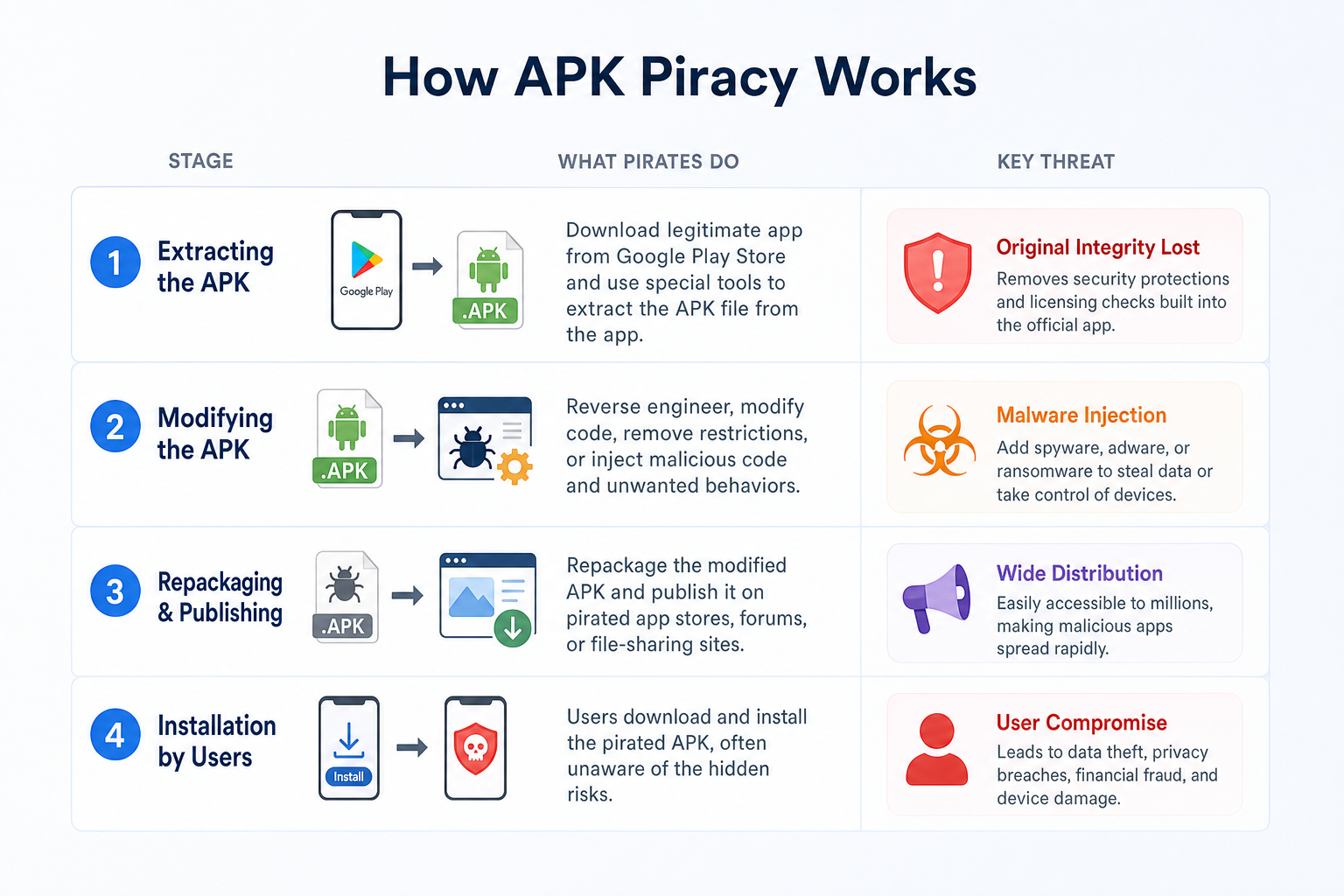
APK piracy is a step-by-step process that starts by finding in-demand apps, continues with the extraction and modification of legitimate APK files into MOD APKs, and ends with their illegal distribution in online platforms.
1 - Extracting the APK
Pirates first target popular apps that have a broad user base. They extract the APK file from a legitimate app, often by downloading it from the Google Play Store and using special tools to get the APK from their device.
2 - Modifying and Repackaging
Next, pirates modify the APK file. They crack the code to remove security measures, such as licensing checks, which verify the app is used legally. By stripping away these protections, the app can be used without paying for it.
Sometimes, malicious code such as malware or spyware is inserted during this stage, turning a pirated app into a potential threat for users. Research on Android app repackaging attacks confirms how attackers redistribute paid apps for free and tamper with their behavior. Users’ personal data or even access to their devices or bank accounts can be put at risk.
After modifying the APK, pirates repackage it. They compile the altered code back into an APK file, ready for distribution. The new file may look similar to the original but operates differently due to the removed security features or added malicious elements.
3 - MOD APK Distribution
Pirates then distribute the repackaged APKs on various illegal platforms, including APK download sites and unofficial app stores. These platforms often lack the security checks found in legitimate stores like Google Play, making it easy for pirates to spread their hacked versions.
Pirates also promote the MOD APKs on forums, social media groups, and other online communities. They’ll commonly use savvy SEO so that these versions appear high in search results.
The Damage of APK Piracy for Businesses
APK piracy has far-reaching consequences that can severely impact businesses in the software industry. Losing out on revenue, adding to customer support demands, and encouraging others to take the piracy route are common damages that come as a result of APK piracy.
Industries Most at Risk
Mobile gaming companies face particularly acute threats from MOD APKs that bypass in-app purchase systems. By modifying popular games, pirates unlock premium currency, remove energy timers, and grant players unlimited resources, which wipes out the game's revenue model completely. For example, MOD APKs of freemium puzzle games commonly disable the gem or coin purchase system, allowing users to access all power-ups and level unlocks without spending a dollar while the legitimate version depends on micro-transaction revenue.
Subscription-based apps including streaming services, productivity tools, and fitness platforms are targeted for credential stuffing and account sharing exploits. Pirates crack subscription verification checks, allowing unlimited free access to premium content and features. MOD APKs of fitness coaching apps, for instance, remove the monthly subscription gate entirely, granting users full access to workout plans, nutrition tracking, and live classes that paying subscribers fund through recurring fees.
Financial and e-commerce apps face the most severe security risks when modified versions circulate. MOD APKs targeting banking or payment apps often contain keyloggers and credential harvesters that capture login details, account numbers, and transaction data. A modified version of a popular mobile payment app might appear to function normally while silently transmitting user credentials to remote servers, exposing both individual users and the app provider to fraud liability and regulatory scrutiny.
Financial Losses
The most immediate impact of APK piracy for a business is the financial loss. When users download pirated versions of an app, they’re getting access to the app’s features without paying your business, which adds up to large amounts of lost revenue from app sales and in-app purchases.
For businesses of all sizes, these losses can add up very quickly and make it financially unfeasible to continue to provide the app’s service.
Increased Customer Support Demands
Piracy can quietly drive up your support costs. People running pirated versions often run into bugs caused by the modified APK, then contact your support team for help, not realizing they're using an illegitimate copy in the first place.
This additional demand will divert resources away from genuine customers and adds unnecessary strain on your support infrastructure.
Normalizing Piracy
Widespread piracy chips away at your competitive edge. When pirated versions of your app are easy to find, paying customers have less reason to keep paying. If they see friends and colleagues getting the same app for free, the monthly subscription starts to feel optional.
That pressure weakens your business model and makes it harder to fund new development and features. The more normal piracy becomes, the more legitimate sales fall, leaving you with less to maintain and grow the app over time.
Malware in MOD APKs
People download MOD APKs to unlock premium or blocked features for free, trusting whatever strangers modified the app. In many cases, the app delivers exactly what was promised: premium features, no ads, and bypassed geo-blocks.
But that trust is often misplaced. Since anyone can modify and repackage an APK, these files are a common vector for hidden malware and spyware that gets bundled into the download without the user's knowledge.
For the businesses behind these apps, it can be tempting to see this as a kind of justice: users who download illegal files to dodge paywalls, then fall victim to malware, should have known better.
Still, no business wants its name attached to harmful files. Misusing a brand this way is unacceptable, no matter what choices the victims made beforehand.
Preventing APK Modification: Development Best Practices
Code obfuscation is your first line of defense against APK modification. Implement ProGuard or R8 during the build process to rename classes, methods, and variables into meaningless strings, turning readable code into a maze that dramatically increases the time and skill required to reverse-engineer your app. Configure obfuscation rules to protect critical authentication logic, payment processing flows, and license validation checks while preserving necessary debugging symbols for crash reporting.
Move validation control away from the client entirely. Never trust the app to enforce premium features, subscription status, or access permissions on its own. Instead, validate every critical action on your backend: confirm user entitlements, check license keys, and verify transaction receipts through server endpoints that pirates can't touch. Add certificate pinning to block man-in-the-middle attacks that try to bypass these checks, and use token-based authentication with short expiration windows to shrink the window of exploitation.
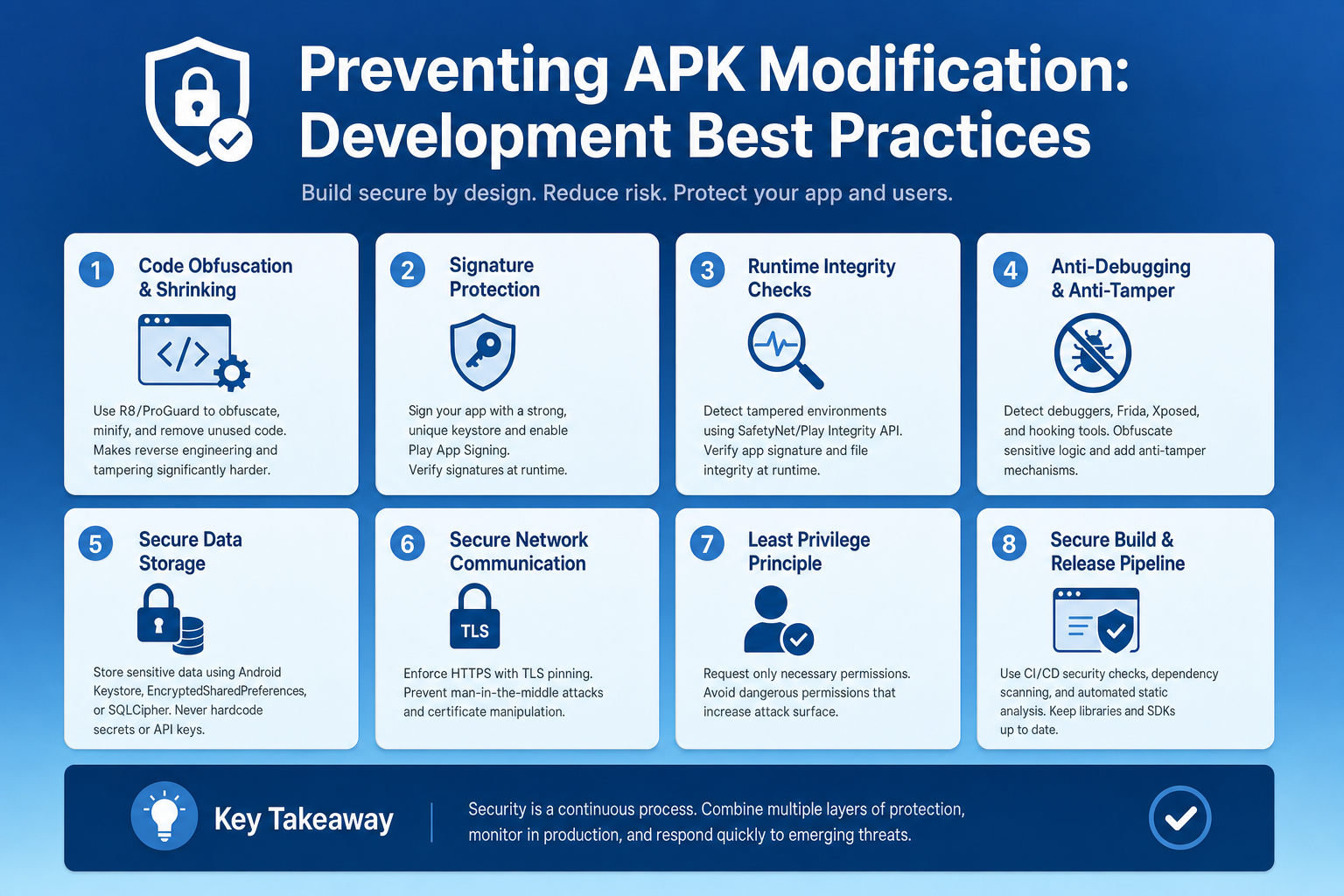
Tamper detection mechanisms alert you when an app has been modified. Integrate runtime integrity checks that verify the APK signature matches your official release, detect debugger attachment attempts, and identify emulator environments commonly used for cracking. Use SafetyNet Attestation API (or its successor, Play Integrity API) to confirm the app is running on a genuine, unmodified Android device. When tampering is detected, gracefully degrade functionality or prompt users to download the legitimate version, a response that preserves the user experience while protecting your revenue.
Regular security audits catch vulnerabilities before pirates exploit them. Conduct penetration testing focused on APK modification scenarios, review your obfuscation effectiveness after each major release, and monitor how quickly security researchers or ethical hackers can crack your protections. Update your defensive measures quarterly as new circumvention techniques appear, and treat security hardening as an ongoing development priority instead of a one-time implementation.
How To Stop APK Modding Threats
Actively monitoring the internet for pirated copies of your app and working to have them removed is an effective, though imperfect method of combating APK piracy. Either by searching yourself or using web crawling tools, finding and removing unauthorized distributions of your app across various platforms is one way of mitigating the spread of MOD APKs.
Once identified, you can take swift action to have these copies removed through DMCA or trademark takedown notices. Many sites will have simple procedures for submitting these requests, though it’ll be a greater challenge on private messaging apps.
The AI Solution
While technology has made it easier to crack, modify, and distribute pirated software, there are anti-piracy software solutions on the other side that are agile and powerful enough to find and remove MOD APKs in minutes.
AI-powered brand protection has become a game-changer against digital piracy. MarqVision’s advanced AI model can quickly identify and remove instances of pirated apps, mitigating damage before it occurs.
FAQ
Can I build APK protection without relying on Google Play Store security alone?
Yes. While the Play Store provides baseline protections, implementing your own server-side validation, code obfuscation with ProGuard or R8, and runtime integrity checks through Play Integrity API creates defense layers that work independently of marketplace controls and catch threats the Play Store misses.
MOD APKs vs legitimate APK sideloading: what's the difference?
Legitimate APK sideloading involves downloading official APK files directly from verified sources (like a developer's website) for manual installation, while MOD APKs are unauthorized, modified versions that crack security features, unlock paid content, or inject malicious code. The key distinction is intent: sideloading delivers the genuine app through an alternative channel, while MOD APKs alter the app's functionality to bypass payment or introduce threats.
How long does it typically take pirates to crack a new app release?
Popular apps with strong revenue models face cracking attempts within 24-48 hours of release. Pirates target high-demand apps immediately, and without code obfuscation or server-side validation, initial MOD APK versions can appear on distribution sites within days of your official launch.
What's the fastest way to detect pirated versions of my app in 2026?
AI-powered monitoring platforms scan APK distribution sites, forums, and social platforms continuously to flag unauthorized copies based on your app's signature, package name, and visual assets. MarqVision's AI detects and removes pirated apps in minutes by crawling over 1,500 platforms where MOD APKs spread, cutting detection time from weeks of manual searching to automated alerts.
Should I focus on takedown requests or strengthening app security first?
Strengthen your app security first if you haven't implemented code obfuscation, server-side validation, or tamper detection. These defenses make cracking harder and slow the spread of MOD APKs. For apps already facing active distribution, pursue takedowns at the same time, but remember that security hardening reduces how quickly new pirated versions reappear after each takedown cycle.
Stay up to date on the latest IP Protection content from MarqVision.




4 Enforcements a Week to 400: Scale Brand Safety with Marq AI

Don’t Just Find Counterfeits. Dismantle the Entire Network.

.png)
Discover the latest trends and challenges in IP protection

Take Control of Your Trademarks with MARQ Folio
Renew and Manage Your Trademarks Easily With MARQ Folio

We’re waiting to hear from you

See the best brand protection solution in action

Don’t let piracy steal your growth

Talk to us about your brand protection problems